Another of our Tucson tours through geocaching took us to some of the historical buildings still standing. This one, The Stork's Nest is by far my favorite because of its history.
originally built in 1883
remodeled to its current condition in 1984
Helen Jacobs' personal tragedy prompted her to buy a home in Tucson in 1922 and convert it into the Stork's Nest maternity ward. Asked if she had ever lost a mother, she answered, "Only one," her daughter, who had died in childbirth in Bisbee. ... Stork's Nest. A maternity home for Tucson women from the 1920s to the 1940s, it was operated by Helen Jacobs and staffed by nurses night and day. Now an office building, it's one of the few places where you can enter to view historical photos about its past. ~ Arizona Health Sciences Library

The next two historical buildings were originally part of the El Presidio Historic District, a residential neighborhood containing adobe and brick buildings in the Spanish-Mexican, Anglo-American and Eclectic architectural styles. Named for the Spanish-built Presidio de San Augustín del Tucson (1775), El Presidio is one of the nation's oldest inhabited sites. The district is on the site of a prehistoric Hohokam Indian site (c. 700-900 A.D.) and the original presidio (fort). The El Presidio Historic District reflects Tucson's development from an 18th-century walled compound to its emergence as a major 20th-century mercantile center.
Hiram Stevens was mentioned in the previous blog post for bringing the first windmill to Tucson to pump water from the wells. This was his residence which featured an aviary, orchard, carriage house, and stables. The home is now the cafe of the Tucson Museum of Art.
The plaque in the sidewalk on the street corner said we were standing at the main gate of the presidio. The Hiram Steven family and the Edward Nye Fish family are two of the three families in the photo.
residence of Edward Nye Fish
today it is gift shop of the Tucson Museum of Art
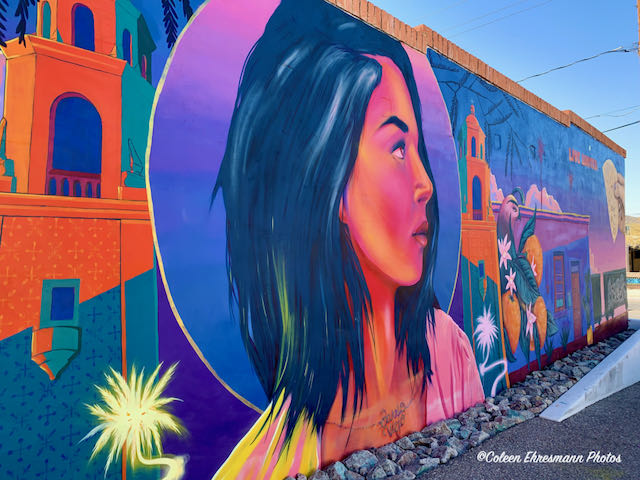
mural in a parking lot across the street
time has taken a toll on this old home in the presidio district
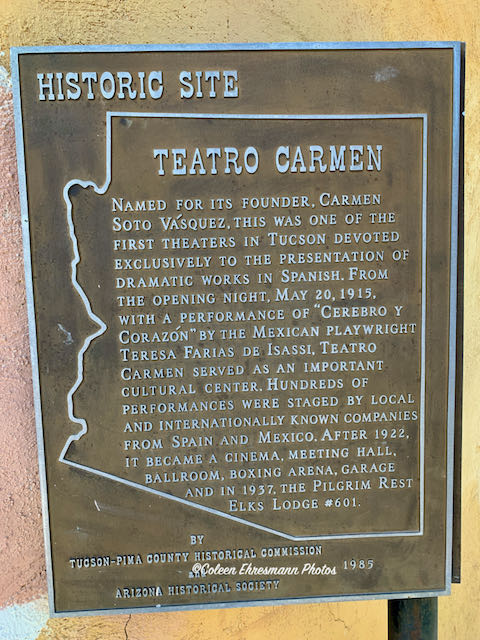
Teatro Carmen
Opening night was May 20, 1915
a theater devoted to dramatic works in Spanish
more interesting information about
Carmen Soto and the theater
the side of the building showing the arched windows
After 1922 the theater became a cinema, ballroom, meeting hall, boxing area, garage and an Elks Lodge. The Teatro Carmen building survived the destruction of the majority of the buildings in the Barrio Viejo during Urban Renewal of the 1950s and 1960s and still stands today. ~ Arizona Memory Project
Ferrin House
This adobe home was built in the 1860s by Joseph Ferrin, a tailor. Their daughter was instrumental in bringing the first synagogue to Arizona. This building was for a time owned by Diane Keaton, the actress. It is now The Coronet Restaurant and Bar.