Showing posts with label art. Show all posts

Friday, February 27, 2026

Cemetery of Recoleta

 The Cemetery of Recoleta - the first public cemetery in Buenos Aires - was built in 1822 by French engineer Prospero Catelin. It is located in the Recoleta neighborhood and owes its name to the convent of “Recoleta” monks. The Nuestra Senora del Pillar church belonged to this congregation and was in the old orchard of the Basilica that the cemetery was built. 

Majestic pantheons and mausoleums belonging to many of the most important characters in Argentine history are throughout the five hectares.  

Built in marble and decorated with sculptures, the work of outstanding architects and artists is on display. More than 90 pantheons have been declared a National Historical Monument. 

We had two reasons to visit this cemetery while in Buenos Aires: visit the tomb of Evita Peron and geocache. 

Here are some of the photos I took while wandering through the cemetery. 

the cemetery side of the entrance
the street side was a nondescript brick wall


very narrow mausoleum 


some had stained glass windows 

a variety of shapes

this was a husband (important person)
and his wife who loved to spend his money

narrow alleys lined with mausoleums 

a rare open tomb with a stained glass dome


some were in need of repairing

others like this one, looked brand new


we could see the burial vault behind this window 

decorated door


at this one, you could look down and see the marble shelves to hold all the vaults of the family members, which were empty

Evita Peron’s mausoleum

looking for the tomb for the Adventure Lab

comparing answers for the bonus geocache
Mission Accomplished!

While many sources cite 4,691 main vaults/mausoleums, some estimates go higher, noting up to 6,400 tombs, statues, and crypts.

The cemetery acts as a "city of the dead" with streets, housing the remains of notable figures like Eva PerĂ³n.


Sunday, February 22, 2026

Hamilton

 OFD  gifted the two of us tickets to see Hamilton on Broadway during our one day stay in NYC on this trip to Antarctica. I think this is my third Broadway show in NYC. What a fabulous experience made better by the fact that I spent two nights prior to leaving SD listening to the music on CDs that were loaned to me to enhance the experience  I was able to read the words as I listened. Then I followed that with some Alexander Hamilton research. 


It was an AMAZING experience. Thanks OFD.


Friday, January 23, 2026

The Grinch

 OFD wanted to see How the Grinch Stole Christmas, which was playing at the Washington Pavilion over Christmas. The two of us had tickets.


statue at the Pavilion, part of the outdoor art display


At first I thought the glass was reflecting the sunset, but it is colored glass. Still impressive. Also part of the art at the Pavilion.


no photos once the musical began


we both enjoyed a Don't Be Grinchy adult beverage


photo collage from OFD

Hubby joined us for pizza after the play


Sunday, July 13, 2025

Oslo ~Cruise Stop #9 ~ The End of the Baltic Sea Cruise

 The cruise ship docked around 7 AM. By 8 AM we were off the ship and looking for transportation to take us to the hotel so we could spend the day exploring our final city on this trip. Half of the ship's cruisers had the very same idea, so finding a taxi or Uber was impossible, as neither could enter the shipyard to pick up passengers. We never did learn why taxis could not enter that area. So we began to walk as OFD said the hotel was about a mile away. We began the UPHILL trek tugging/pulling our rolling suitcases on narrow, cobbled sidewalks. No breakfast. No coffee. Did I mention we had to go uphill? After what felt like hours, we did arrive at the hotel to leave our luggage and find a recommended eating place. 

That was our start to two days in Oslo, Norway.

Oslo Tree

The Oslo Tree is an art installation gifted to the people of Oslo by Canica AS, a company owned by Stein Erik Hagen.

The tree is 14 meters tall, 12 meters wide and weighs 27 tons altogether. 125 000

LEDs create a colourful, computerized display, tailored to the seasons. ~ signage at the tree


The geocache was located just outside the port's fence and near The Oslo Tree. The tree was so cool as it looked very much like a real tree.


These four black and whites were part of a mural on a building near the port area. The Route 66 sign and the bison were reminiscent of scenes from home.

Our lunch location was near the palace, so that was our destination for the afternoon. OFD headed off to explore other areas of the city.


one of the walking paths in the Palace Park

The Palace Park was opened by King Oscar I in 1847, two years before the Royal Palace was completed. Ever since then the Royal Family's park has been open to the public all year round, making it unique in Europe.*


The Palace Park was designed by the Palace architect H. D. F. Linstow in 1838 and was laid out between 1838 and 1860 by the first gardener at the Royal Palace, Martin Mortensen. Most of the trees in the park, originally numbering more than 2 000, were planted in 1842.


Early descriptions refer to the park as lush and abundant with flowers. Over the years the Palace Park has been steadily simplified to include fewer ponds and plants than previously.*


Today the park is characterised by large lawns and voluminous trees, although the number of trees has almost been halved as a result of old age and damage over time.*


 The Garden Section at the Royal Palace is now working to restore elements of the park's original diversity, with shrubs and flowers planted beneath the trees. The park is a cultural heritage site and is managed by the Palace gardeners in accordance with eco-friendly principles. * ~ signage in the park


The Royal Palace
Building activities commenced in 1824, and the foundation stone was laid by King Carl Johan on 1 October 1825. The Palace was officially taken into use on 26 July 1849 by King Oscar I.**


The Royal Palace is built in Neo-Classical style with a facade of stuccoed brick. The building has two wings and is three storeys high.**


The Royal Palace is owned by the state and placed at the disposal of the head of state. It is where the daily work of the monarchy is conducted and where the King and Queen live. It is where the King presides over the Council of State, grants audiences and holds official dinners. Foreign heads of state who visit Oslo stay at the Palace. Most of the members of the Royal Court have their workplace here.**


The Royal Palace is situated on a rise, the Bellevue, at one end of Oslo’s main thoroughfare, Karl Johans gate. The Royal Palace is one of the country’s most important buildings, and a concrete symbol of the course of Norwegian history since 1814.** ~ The Royal House of Norway


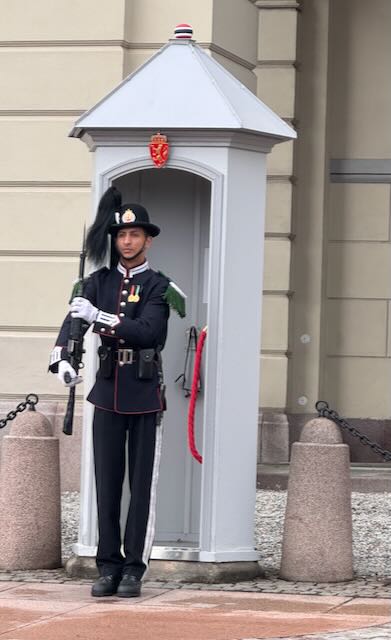
We were treated to a parade and some music while we explored the palace grounds.


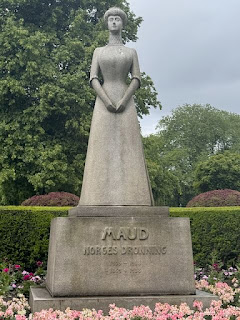
Crown Princess Martha & Queen Maud


The Princess Ingrid Alexandra Sculpture Park
The Princess Ingrid Alexandra Sculpture Park was opened 19 May 2016 as part of the celebration of the King and Queen's 25th anniversary. 1 000 children from local kindergartens were also invited to the opening, as this is a sculpture park by - and for - children. Today the sculpture park consists of 12 sculptures - a result of a nationwide competition among 5th and 6th graders. ~ The Royal House of Norway

We spent most of the afternoon in the Palace Park to complete the geocaching Adventure Lab.


We celebrated our 55th wedding anniversary (June 6th) in Oslo. We celebrated with dinner at McDonalds for two reasons: it was raining hard and McDonalds was close to the hotel. 


the hotel in Oslo


the cool elevator door in teh hotel

Next: the last day in Oslo