Tallinn is the capital city of Estonia. Our goal at this cruise stop was to explore the Old Town of Tallinn because of its castle and medieval history. We used a Hop On Hop Off bus to get to Old Town, exploring on foot from there.
The origins of Tallinn date back to the 13th century, when a castle was built there by the crusading knights of the Teutonic Order. It developed as a major centre of the Hanseatic League, and its wealth is demonstrated by the opulence of the public buildings (the churches in particular) and the domestic architecture of the merchants' houses, which have survived to a remarkable degree despite the ravages of fire and war in the intervening centuries. ~ UNESCO
Toopea Castle
Old Town Tallinn is divided into two sections: the castle and church on Toompea Hill and the lower section of town housing the merchants' shops and homes. The HOHO bus stopped at Toompea Hill.
signage of the castle today

Toompea Castle is the seat of the Parliament of Estonia, the Rigikogu. The complex of the buildings of Toompea Castle is made up of the medieval fortress with its western wall and the Tall Hermann Tower, the Classicist palatial Province Government building from the 18th century, and the Expressionist-style Rigikogu Building in the castle courtyard. Toompea has been the seat of power in Estonia for 800 years. ~ Taken from signage at the castle
As we walked up the hill from the HOHO bus stop, this was our first glimpse of Toompea Hill, the cathedral.
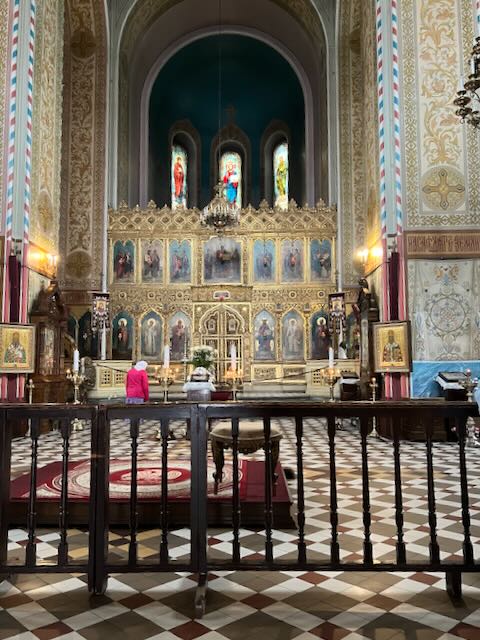
Alexander Nevsky Cathedral
This richly decorated historicist mixed-style Orthodox church was completed in 1900 when Estonia was part of the Russian Empire. The church dates back to the Russification policy in the 19th century and was erected directly opposite Toompea Castle to demonstrate Russian supremacy. ~ Visit Tallinn
There was a church service in progress, so no photos were allowed. However, we could peek. OFD got one quick photo before we had to exit.
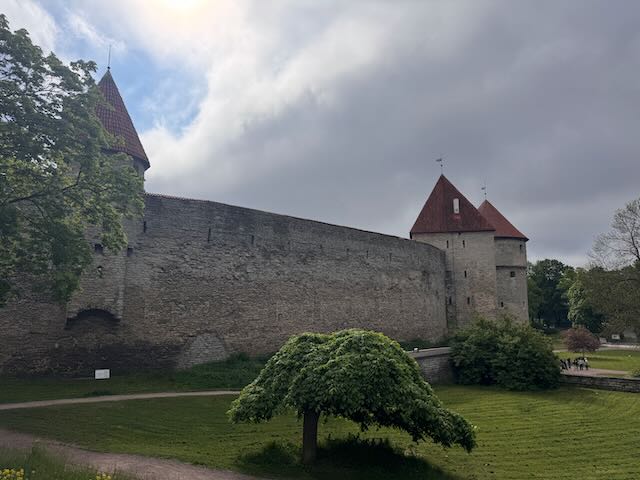
Kiek in de Kök Fortifications Museum
The round tower on the far right is an artillery tower built in 1475. It got its name "Peek into the Kitchen" because tower occupants could peek into the kitchens of nearby houses.
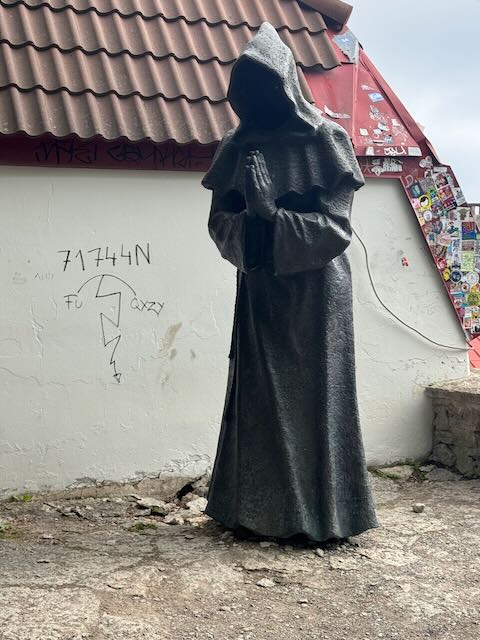
Bartholomew "Praying Monk"
one of the 3 Monk Sculptures in the Danish King's Garden
created by Simson von Seakyll (Aivar Simson) and Paul Mänd
and installed in the Danish Kings Garden in 2011
"Watching Monk" Claudius
"Waiting Monk" Ambroise
I am not certain when the fortification wall was built, but in 1311 it was the demarcation line between the lower town and Toompea. Residents could freely move from the lower town and the castle on the limestone hill. The towers were added during different time periods and under different ruling leaders.
Lesser Coat of Arms of Tallinn
Danish reign in northern Estonia lasted for nearly 100 years in the 13th century.
According to an old legend, this is the spot where a flag descended from the sky during the Danish invasion, and it was this flag that turned the course of the battle in favour of King Valdemar II. Later, the flag became the national flag of Denmark. Every year on the 15th of June, Dannebrog or the Day of the Danish Flag is celebrated in the garden. ~ Visit Tallinn
We continued down the hill, walking narrow streets through archways to reach Old Town Square.
St. Nicholas Church and Museum
geocaching at the museum
doors to the museum entrance
doors inside the museum
St. Nicholas Church was originally built as a Catholic church in the 13th century, became Protestant (Lutheran) in the 1500s, and was partially destroyed by Soviet bombing in WWII. The church has been restored, but is no longer an active church.
It is now a branch of the Art Museum of Estonia, focusing mainly on ecclesiastical art from the Middle Ages onward. It is also used as a concert hall. ~ Wikipedia
rather spooky looking!
The church is the concert hall because of its exceptional acoustics.
interesting and different sculpture on our walk to the square
another squirrel moment
Old Town Square
There has been a town hall in Tallinn since at least 1322 and a town square next to it ever since then. The hall was rebuilt from 1402 to 1404 into its current form, and a Christmas tree display has been held in the square since 1441, making the Tallinn Christmas tree display over 580 years old. ~ Wikipedia
Tallinn Town Hall
This is the oldest surviving town hall in Northern Europe. First mentioned in 1322, the building history of Tallinn Town Hall goes back to the 13th century. The management of the city worked in the Town Hall until 1970. Today, the Town Hall functions as the ceremonial building of the city government. ~ Tallinn Town Hall
Finding the
Chimney Sweep Monument was due to geocaching. It was erected in 2010 in the Savoy Hotel Square, not far from Town Hall Square.
our geocaching souvenir from Estonia
Women were selling bouquets of Lily of the Valley for 10 euros. They smelled so good.
I saw several of these concrete sculptures of birds (doves? pigeons?) while wandering in Old Town Tallinn. Most often I saw them along the city streets. Come to find out, they are placed as traffic barriers. But many of the tired tourists found them to be a place to rest, as there were no benches, and if you sat on a chair at a sidewalk cafe, you were expected to make a purchase, even if you were addressing a postcard to your grandkids.
These three were retired barriers, at least for now, in the Freedom Square.
And finally, scenes we saw while riding the HOHO to the pier and our ship.
Pirita Convent was a Bridgettine convent for both nuns and monks, located in the district of Pirita in Tallinn, Estonia. It functioned from 1407 to 1575 when it was looted and burned by Russian troops under the leadership of Ivan the Terrible. It was the largest convent in Medieval Estonia. Today, the grounds of the convent are used as a cemetery. ~ Wikipedia
(Wikipedia photo)
The four walls of the convent remain.
our ship backed into the pier, awaiting its passengers
"Wave," constructed of metal strips, is located near Old Port
There is so much more, places and history, that we saw during our time in Tallinn. It is a very interesting city and worthy of a longer visit.
Next: Riga, Port Stop #3


.jpeg)





.jpg)


