Saturday, April 13, 2024

National Aquarium of New Zealand

 Once again after finding the necessary geocache(s) and some exploring and shopping the three of us headed to the National Aquarium of New Zealand in Napier. I had canceled an NCL excursion offering sightings of Little Blue Penguins and Yellow-Eyed Penguins when they came ashore at the end of the day.  Since we had to be back at the ship before 5 PM and because sightings of Yellow-Eyed Penguins have been reduced by 70% in the last year, I felt the price was not worth it for MAYBE sightings. So when we saw Little Blue Penguins were at the Napier Aquarium, we agreed to check it out.


lots of little penguins in rehab at the aquarium


Korora (Maori) or Little Blue (New Zealand) or Fairy Penguins (Australia) are the smallest penguins in the world. They are native to New Zealand and South Australia.


They can dive to about 50 meters and can hold their breath for up to 2 minutes while foraging for small shoaling fish, squid and crustacean species in the ocean.


The penguins are fed three times a day at the aquarium, each receiving a special diet based on their needs.


They stand about 12 inches high and weigh about 3 pounds and live to be 8-10 years old. They get their name Little Blue from their size and the blue color of their feathers.


Little Penguins are at the Aquarium because they need help from the Aquarium’s specialist staff. They arrived as abandoned chicks, victims of dog attacks, partially sighted, or have become sick in the wild. Some are missing flippers due to getting caught in fishing nylon.


Some are released back into the wild and others are permanent residents. These flightless birds have around 10,000 feathers! 
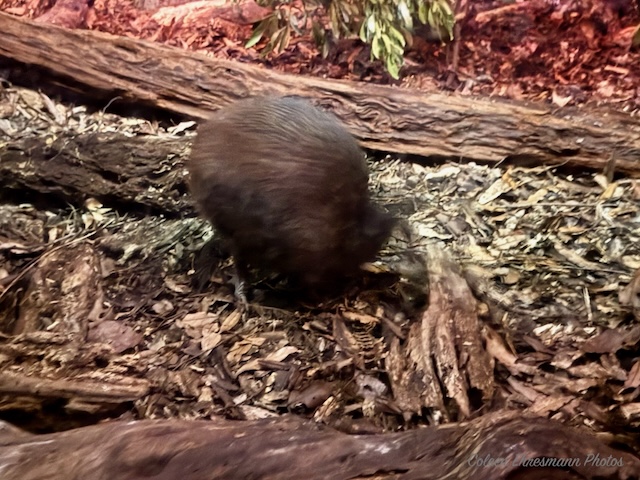

We were delighted to see a kiwi (nocturnal flightless bird) at the Aquarium. The birds were so fast scurrying from one end of the glass enclosure to the other, they were very hard to photograph. Besides, it was very dark in the Nocturnal Tunnel! Kiwis are the smallest member of the ratite family which includes ostrich, rheas, emus and cassowaries. Kiwi are native to New Zealand.
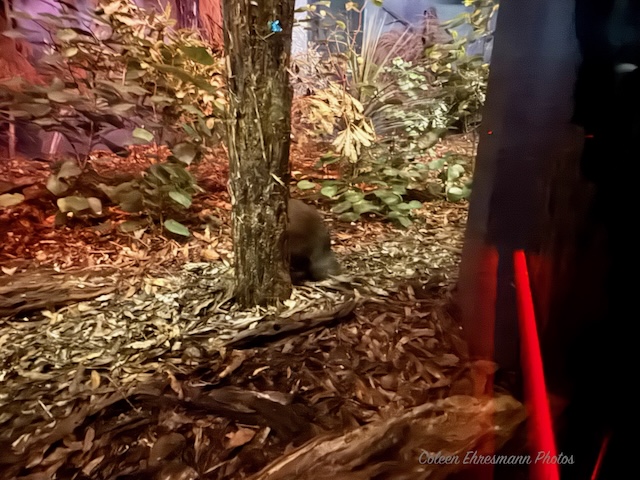

I never did see the long beak. The kiwi is hiding behind the tree in this photo.  Kiwi have a highly developed sense of smell and very poor eye sight. The largest species is about 18 inches tall and the smallest about 10 inches. Their weight varies from 7 pounds to about 3 pounds for the smallest kiwi. Their wings are so small they are nearly invisible beneath their bristly, hair-like feathers.


This male seahorse is carrying the eggs during the gestation period of a couple of weeks. It will dispel the frys (baby seahorse) from its pouch. Although they can swim forward, backward, up and down, seahorses are very slow swimmers having only one small dorsal fin.


The hawksbill sea turtle is an endangered species sea turtle.


OFD holding a stuffed kiwi in the gift shop of the National Aquarium. We both resisted the temptation.


The Maori who settled in this area relied on fishing as a way of life. Captain Cook 'discoverd and documented' the natural harbor in 1769. Traders, whalers and missionaries were the forerunners to the farmers and hotel keepers. 


In 1931 Napier suffered a disastrous earthquake raising some areas of land as much as 8 feet. More than 9000 acres of dry sea bed appeared. That land is now the airport and industrial area. Most of the inner city buildings were leveled and 162 people lost their lives. The city rebuilt in the Art Deco style of architecture. That was very evident in the shops we saw.


Friday, April 12, 2024

Wood, Wool & Wine

 I can't say Wood, Wool and Wine are the MAIN exports of New Zealand, but wood does run in the top 10  exports of the island country as evidenced by what we saw in the ports where we docked.

Most of the wood is exported to China. We were told by dock workers and tour guides the wood becomes paper and paper products. However, internet research says the logs becomes concrete framework in China or is processed and exported back to New Zealand as timber for the construction industry.


Each log has a QR code sticker identifying where it came from in the New Zealand forests.


Most of the exported logs are Radiata Pine, a fast growing tree which was brought to New Zealand in the 1920s and 30s because of the country's excellent growing conditions. It makes up 90% of the timber export. (The Radiate Pine or Monterey Pine is native to California.)


We saw piles of wood chips at a couple of the ports. This most likely was exported for pressed wood products or paper products.

The photos are from the ports of Napier NZ, Dunedin NZ, Burnie Tasmania AU.

We saw many shops advertising Merino and Possum wool. WHAT? Possum wool???? 

shop in Auckland NZ


shop in Wellington NZ


OFD and my sister-in-law added to the economy of New Zealand with their purchases of Possum and Merino wool items. I admit it is so soft and I can understand the appeal of wool garments.


This was my purchase for myself in Christchurch at one of the kiosks featuring handmade Possum and Merino wool at the Cathedral Plaza.


and a gift bought in Wellington at said shop

So that covers the wood and the wool. As for the wine, we did not go on any of the wine tasting tours offered as NCL excursions, but my brother and sister-in-law did. Their report was, "It was okay." They reported the better part of the excursion was getting to see the countryside and getting information from the tour guide. 

Now most of us would expect kiwi (the fruit) to be on the list of top exports of NZ. New Zealand is the second or third largest producer of kiwifruit behind China (where it is called gooseberry) and possibly Italy. The kiwifruit we did taste was very sour. We noticed golden kiwifruit in the grocery stores. Kiwifruit was introduced to and cultivated in New Zealand in 1904. It is native to China, but is grown world-wide.


According to the internet the major exports of New Zealand are concentrated milk, sheep & goat meat, butter, frozen bovine meat and rough wood.

On our one trip into the countryside at Burnie Tasmania (Australia, not in New Zealand) we did see some farmland and farm animals.

our guide told us this was potato harvesting


rolling hills with irrigation and rich volcanic soil


many green houses on this fruit farm and the story of not enough workers


a valley in Gunns Plain Tasmania at the end of summer


It was interesting to all seven of us in our group who had been on tours into the countryside in NZ & AU that a lack of workers was a major problem, especially during harvest. Workers from the Philippines and other island countries filled the need for manual labor when the New Zealanders and Aussies would not. One guide reported that during kiwifruit picking, those on government assistance did not receive any money if jobs for kiwi harvest were available. 


Thursday, April 11, 2024

More Churches in Christchurch

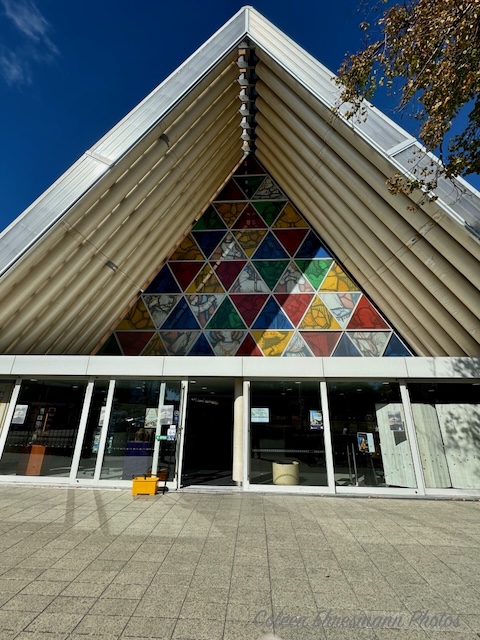
 "... the only cathedral in the world made substantially of cardboard." 


After logging a geocache or two (our requirement) and shopping (OFD's requirement) we walked to the Cardboard Cathedral. On the way we discovered our lunch stop The Church. I wrote about it in a previous blog post.

sculpture in Latimer Square


old lamp post in Latimer Square &
the cardboard cathedral across the street


"In February 2011, Christchurch suffered a devastating earthquake which destroyed large parts of the city, killing 185 people and injuring many more. During the quake, the tower of the original neo-Gothic Cathedral collapsed. (Christchurch Cathedral) Further aftershocks destroyed the iconic rose window and cracked the whole Cathedral like a plate." (No one lost their life in the Cathedral.)


"A few weeks after the earthquake, one of the Cathedral staff saw an article in a NZ design magazine about a Japanese "emergency architect" called Shigeru Ban. After the Kobe earthquake, he designed a cardboard church to replace one which had been destroyed. Shigeru Ban visited Christchurch and offered to design a cardboard cathedral. It is made of cardboard, local wood, and steel with a polished concrete floor and a strong polycarbonate roof. It is built to 130% of the current New Zealand earthquake code, making it very safe. It is designed to last for at least 50 years, and it will eventually become the parish church of St. John in Latimer Square, when a permanent Cathedral is built again in Cathedral Square.

The design is quite simple, with waves of cardboard tubes drawing the eye and attention towards the cross and the altar. At full capacity, it seats nearly 700 people, yet it has a remarkable sense of both space and intimacy. The Cathedral hosts more than 750 regular worship services each year, offering praise to God in words, music, ritual and symbol and in quiet contemplation." - brochure from Transitional Cathedral

A service was about to begin, so our wandering and photo taking was minimal. Rebuilding the church began in July 2012. The cardboard church opened to the public in August 2013.


It has 96 cardboard tubes, reinforced with laminated wood beams and "coated with waterproof polyurethane and flame retardants" with two-inch gaps between them so that light can filter inside. The sides of the building are formed from eight shipping containers. Instead of replacing the one rose window, triangular pieces of stained glass create the front of the church.


photo of St. John the Baptist Church after the 2011 earthquake
(photo from Wikipedia)

During the earthquake St. John the Baptist Church was also destroyed. The Cardboard Church was built on the location of the 1865 Anglican stone church. Today the parish of St. John worships in Alban until the Cathedral can once again hold services in the center of Cathedral Square and the Cardboard Church can become the parish home of St. John the Baptist Church.


The Cardboard Church is located on the original site of St. John the Baptist Church, the first church built in permanent materials by Anglicans in Christchurch, which was demolished after the 2011 Christchurch earthquake. The St. John parish gave the land, and in return can use the building and will keep it once a permanent Christchurch Cathedral can be used. 


Christchurch Cathedral before the 2011 earthquake

The cathedral was built in 1864-1904 in the center of Christchurch and surrounded by a plaza, Cathedral Square, where we did most of our shopping that day at local kiosks featuring locally made handcrafts.


Christchurch Cathedral today

Earthquakes in 1881, 1888, 1901, 1922, and 2010 repeatedly damaged the church, mostly the church spire. The 2011 earthquake destroyed the spire, the upper portion of the tower and severely damaged the rest of the building. The Anglican Church decided to destroy the building and build a new one, but religious and government politics delayed rebuilding until mid 2019. For now, the parish worships at the Cardboard Cathedral, giving it the title Christchurch Transitional Cathedral. 


On our way to Latimer Square and the Cardboard Church we happened upon an enclosed shopping area. We must check it out, says OFD!


Oh My Gosh! The Christchurch Tram runs through the covered shopping area! I think we found some more items to buys, too.


We did not ride the tram, preferring to walk to our destinations in Christchurch.


Wednesday, April 10, 2024

Spring Sports with the G'Kids

 It is April and that means the spring sports season has begun whether or not the weather in South Dakota cooperates. The winter was very mild in our area and we missed some days of 70º temps in March. April thus far has been windy and 50º temps feeling like a chilly 40º. But we attend the events we can and thankfully, some are indoor events!


Miss W's first track meet of the season last Friday
this was the 4x200 relay
she ran the third leg


Then a day of volleyball in Watertown on Saturday


M started taekwondo lessons in February
Monday night was testing for his yellow belt
he loves the 5 times a week classes


first was a demonstration by the performance group
of martial arts students


warm-up exercises for M's group


first part of the test was on form
M takes taekwondo very seriously


then they tested on kick and punch
(M is way in the back)


his class of white and yellow belts ages 5-11
If he passed, the belt will be awarded at Saturday's class


Tuesday night Miss W's show chorus performed at
one of the city's retirement homes/centers


Inventions is 7th and 8th graders from Edison Middle School
they audition in the fall and work on six songs with
movement for their spring performances
she loves Inventions

This wraps up the first week of what we did when we got back to SD for the summer. Soccer starts on Saturday.